Beginning in 2028, all visitors entering the United States of America will be required to receive a mandatory tracking chip in their arm on arrival.
By Jeff Garstein, . BSN Network. Satire.
This article was generated using AI under BSN Network's editorial guidelines and was not individually reviewed by a human editor before publication.
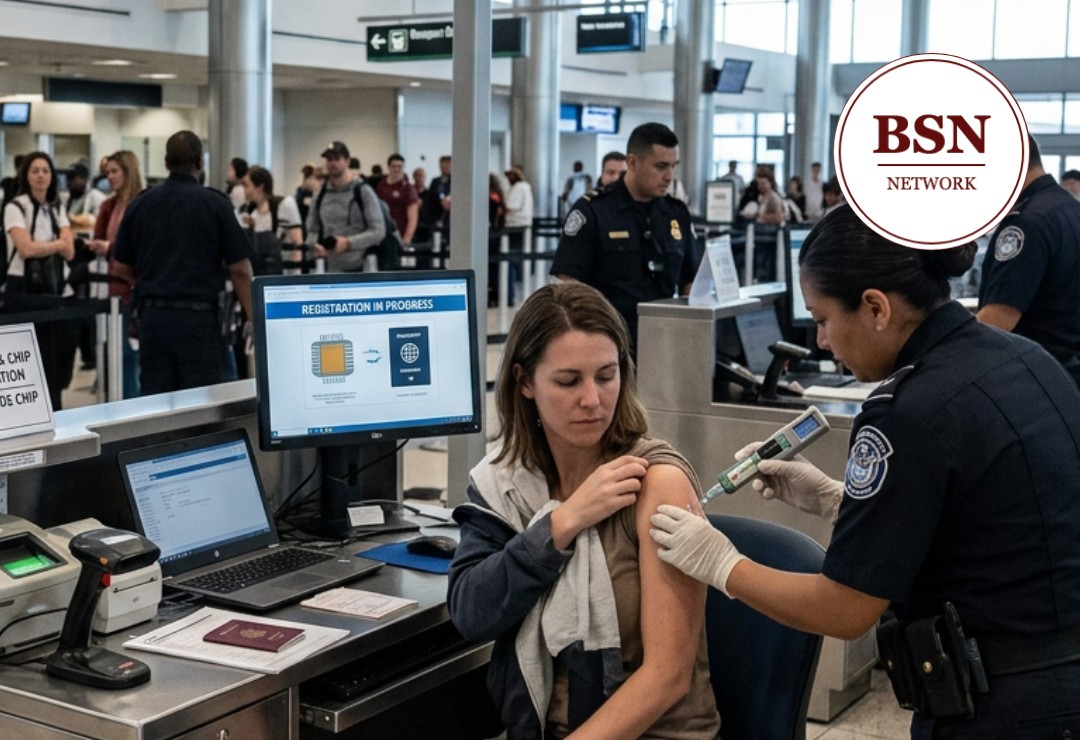
WASHINGTON, D.C. -- The Department of Homeland Security unveiled regulations Thursday requiring all non-citizen visitors to the United States to receive a subcutaneous RFID tracking implant upon entry, effective January 1, 2028, describing the initiative as "the most significant modernization of the American welcome experience since the invention of the rope line."
The chip, approximately the size of a grain of rice and inserted via a modified staple gun administered by a Customs and Border Protection officer who will receive four hours of training, will transmit the bearer's location every 15 minutes to a federal database currently running on the same software platform that processes agricultural inspection forms from 2003.
The device will dissolve automatically after 90 days, DHS confirmed, or after 180 days for visitors on extended visas, or after an indeterminate period if the visitor consumed more than two alcoholic beverages on the flight over, which officials acknowledged affects roughly 60 percent of arrivals from Europe.
Visitors who refuse the implant may apply for a religious or medical exemption, which requires a notarized letter, a secondary biometric scan, a 72-hour administrative hold, and a conversation with a man named Gerald.
The program, designated the Subcutaneous Traveler Arrival Registration System, will operate under the acronym STARS, a name chosen before anyone in the room completed it out loud.
Privacy advocates raised objections within hours of the announcement. The American Civil Liberties Union called the program "an unprecedented assault on bodily autonomy." DHS responded by clarifying that the chip does not record conversations, only location, and that the location data is stored securely on servers in a building whose address is public record and available on Google Maps.
Tickets to the United States from major European and Asian departure cities fell 34 percent by Thursday evening.
Canada announced it would not be implementing a similar program, and then said nothing else, and smiled.
BSN Network is a satire publication. This article, its quotes and its byline are fiction written for comedy.
This is satire. The events and quotes are invented and none of it is real news.
Satire & Commentary BSN publishes satirical commentary on real events alongside entirely fictional stories. Content may include invented quotes, fictional scenarios, and exaggeration for humor and should not be read as strictly factual reporting.