Absurdity
Fossil Fuel Lobbyist Explains Clean Air Cuts into Corporate Profit Margins
By BSN Staff, . BSN Network. Satire.
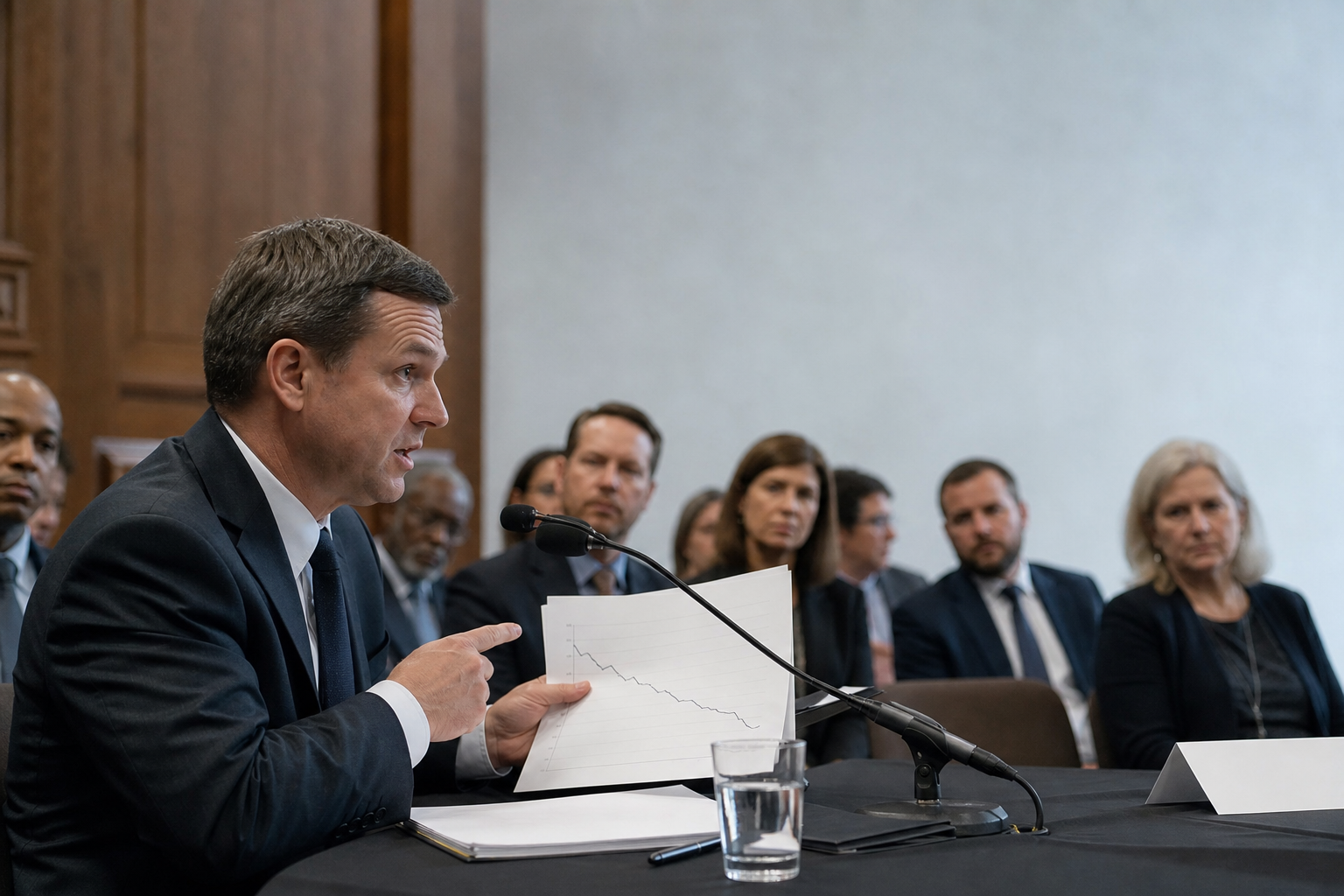
WASHINGTON, D.C. A fossil fuel lobbyist named Garrett Phelps testified before the Senate Subcommittee on Energy Infrastructure on Wednesday and explained, in a calm and professional tone, that cleaner air quality standards are materially impacting the profit margins of his clients, and that Congress should consider this before doing anything rash, like continuing to breathe.
Phelps, a senior partner at the lobbying firm Caldera Whitmore Group, which represents eleven of the country's largest coal and natural gas producers, opened his remarks by thanking the subcommittee for its time and noting that he had prepared a seventeen-slide presentation, twelve of which were graphs, four of which were the same graph at different zoom levels, and one of which was a photograph of a mountain that he said represented "the American spirit of resource independence."
"Every percentage point reduction in particulate emissions costs this industry somewhere between $200 million and $400 million annually in retrofitting, compliance staffing and regulatory overhead," Phelps told the subcommittee. "Clean air is not free. Somebody is paying for it. That somebody, right now, is Devon Energy."
Devon Energy's second-quarter earnings were $1.4 billion.
Phelps then walked the subcommittee through what he called a "respiratory burden matrix," a color-coded spreadsheet correlating air quality index improvements in twelve states with corresponding drops in his clients' EBITDA. He acknowledged that respiratory hospitalizations in those same states had declined by roughly 30 percent over the same period, but noted that this was "a public health metric, not an energy metric," and therefore outside the scope of his presentation.
Senator Diane Hollowell of Oregon asked Phelps whether he was aware that people needed air to survive.
"With respect, Senator, I am not here to litigate biology," Phelps said.
Phelps's fourth slide, titled "The Hidden Cost of Visibility," argued that reduced smog in urban corridors had increased recreational foot traffic, which had in turn raised real estate values in areas adjacent to refineries, making it harder for his clients to expand operations without triggering community opposition. He called this "the gentrification feedback loop" and said it was, in his view, "an underreported crisis."
He spent six minutes on this slide.
The lobbying firm's disclosure forms, filed with the Senate Office of Public Records, show Caldera Whitmore billed $2.3 million in the first half of this year, not including the $840-per-hour appearance fee for Wednesday's testimony, which Phelps confirmed when asked, and then confirmed again more quietly.
When Senator Marcus Tibbs of Kentucky, who has received $340,000 in campaign contributions from Caldera Whitmore clients since 2018, asked Phelps what the subcommittee could do to help, Phelps said he was glad the question had been raised and produced a two-page summary document he called a "regulatory relief menu."
The menu had three tiers: Standard, Premium and Platinum. Senator Tibbs asked a follow-up question. It was not a tough one.
Phelps closed by noting that his clients were not opposed to clean air in principle, only to clean air "as a mandated, uncompensated corporate expense," and that there was an important distinction between those two positions that he hoped the subcommittee would take seriously.
In the hallway after the hearing, a Caldera Whitmore associate handed reporters a laminated copy of the respiratory burden matrix, along with a branded tote bag containing a water bottle, a pen and a card that read: "Caldera Whitmore Group: Energy, Innovation, Tomorrow."
The water bottle was empty.
This is satire. The events and quotes are invented and none of it is real news.