Politics
U.S. Blows Up Five Iranian Oil Tankers Then Acts Surprised Gas Is Four Dollars
By BSN Staff, . BSN Network. Satire.
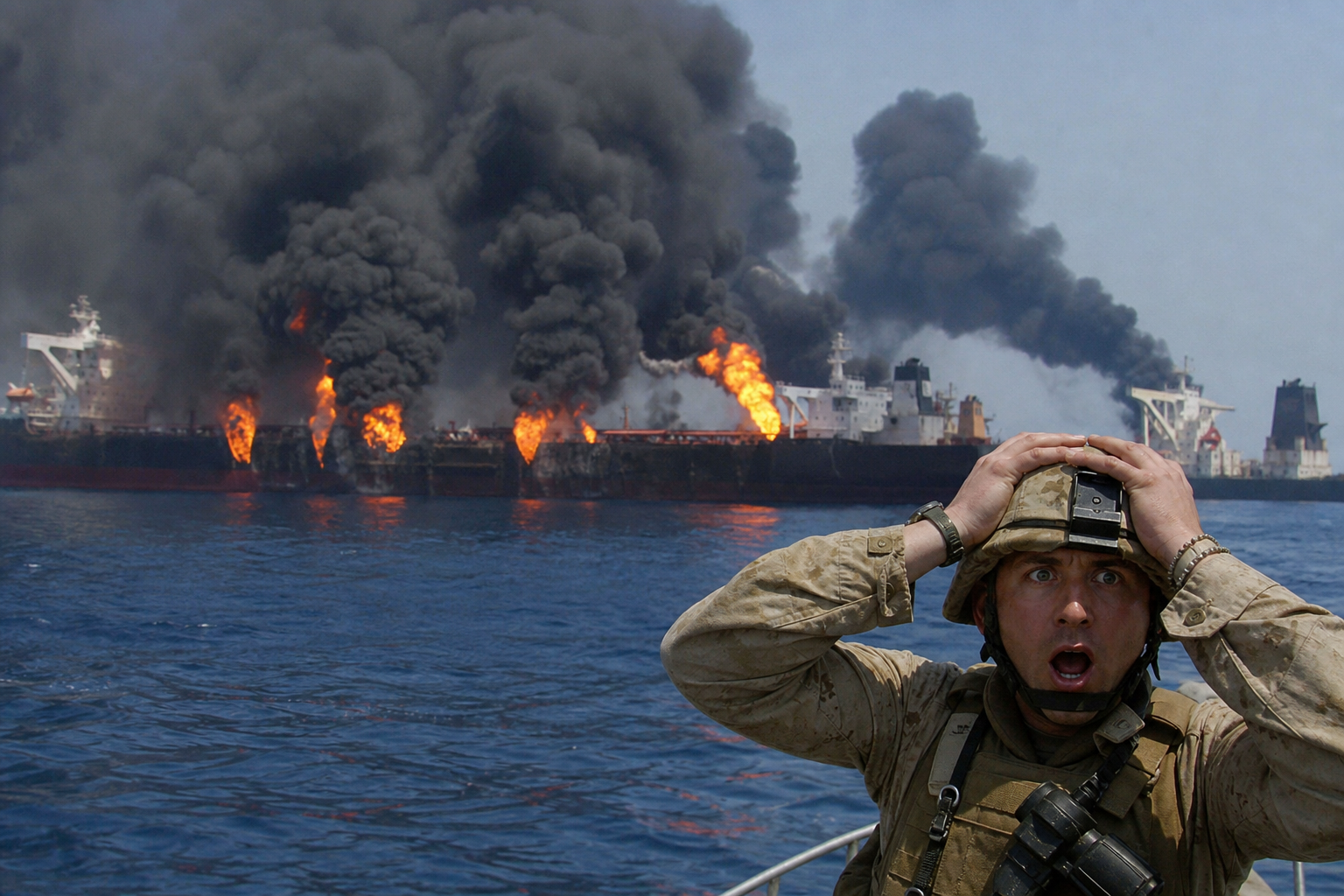
WASHINGTON, D.C. -- The price of crude oil surged past $100 per barrel Monday, reaching a seven-week high, after the United States military confirmed it had destroyed five Iranian oil tankers in the Strait of Hormuz over the weekend. Iran responded by launching retaliatory strikes on two American naval vessels in the region. Markets, operating on the radical assumption that fewer tankers means less oil means higher prices, reacted accordingly.
The White House called the tanker operation a success.
"These vessels were being used to finance a regime that threatens regional stability," said National Security Council spokesman Derek Paulsen, at a podium, with a straight face, while the price of a barrel of oil climbed seventeen dollars in the background. "We will not allow Iran to use its energy exports as a weapon."
The United States will, however, allow the resulting energy crisis to function as a weapon against the American consumer, which is a different and apparently acceptable arrangement.
Iran's Revolutionary Guard called the U.S. strikes an act of war and vowed a "measured but devastating" response, which in diplomatic terms means they have not yet decided what to blow up but want everyone to know they have strong feelings about it. Tehran also announced it was suspending three oil shipping agreements with European buyers, a move analysts described as "textbook" and "extremely predictable" and "something we maybe should have considered."
By Tuesday morning, Brent crude was trading at $101.40. Shell, ExxonMobil and BP each posted premarket gains. A spokesperson for the American Petroleum Institute said the institute was "monitoring the situation closely," which is the oil industry's way of saying they are watching their bank accounts refresh.
At a Shell station in Akron, Ohio, regular unleaded hit $4.19 per gallon by noon.
"I don't understand how this keeps happening," said Gary Fenwick, 54, filling his Ford F-250. Gary voted for energy dominance. Gary is now experiencing it.
The Pentagon insists the tanker strikes were narrowly targeted and legally justified under existing authorizations for the use of military force, a document that was written in 2001 and now apparently covers Iranian shipping in the Persian Gulf, the gig economy, and probably Gary's truck payment.
Defense Secretary officials briefed congressional leaders Monday afternoon. Senator Maria Cantwell of Washington reportedly asked whether anyone had modeled the oil price impact before the operation. According to two people familiar with the meeting, there was a pause described as "long" before someone said the word "dynamic."
Meanwhile, Iran's oil minister announced Tehran would be redirecting its remaining tanker fleet through alternate routes and offered discounted crude to China and India at $88 per barrel, which is $13 cheaper than what Americans will be paying at the pump by Thursday.
Analysts at Goldman Sachs raised their year-end oil forecast to $115 per barrel. They did not say this was bad news, because for Goldman Sachs it is not.
The five destroyed tankers were, according to Pentagon estimates, carrying a combined 1.2 million barrels of oil.
That oil is now on the floor of the Persian Gulf.
The story we are making fun of: https://www.cbsnews.com/live-updates/iran-war-us-tankers-attacks-strikes-strait-of-hormuz-oil-price/