Culture
Green Day Signed One Major Label Deal and Lost Their Punk Library Card
By Bruno Von Falken, . BSN Network. Satire.
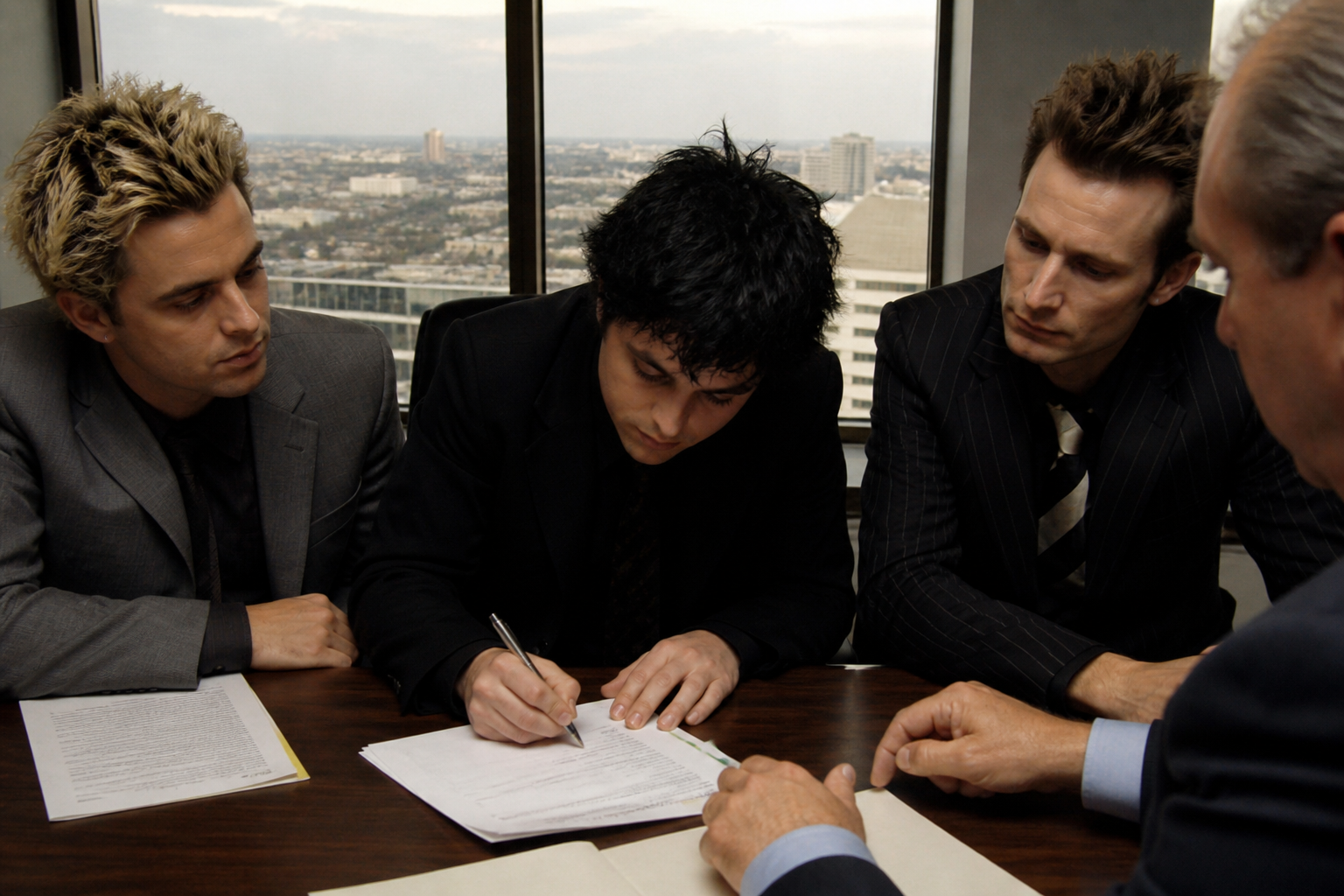
In 1993, Green Day, a three-piece punk band from the East Bay who had been performing since their collective shoe size averaged roughly a men's nine, accepted a recording contract with Reprise Records. This is a label owned by Warner Bros., which is owned by a succession of corporations that have, over the years, owned each other in rotating configurations too depressing to diagram before noon.
The response from 924 Gilman Street, the beloved all-ages punk collective in Berkeley that had served as the band's creative home, spiritual nursery, and primary source of sweaty formative experiences, was swift, principled, and completely in keeping with the long punk tradition of staging a revolution and then policing who gets to attend it.
Green Day was banned.
Not banned for anything involving a fire, a debt, or the kind of interpersonal incident that gets someone quietly removed from a holiday mailing list. Banned for the specific offence of signing a piece of paper that would eventually result in Billie Joe Armstrong being able to afford a house. In the Gilman Street philosophical framework, this was not a career decision. It was a betrayal. It was collaboration. It was, and this is the word the community reached for with the confidence of people who have never had to negotiate a publishing deal, selling out.
Vice, in a recent piece commemorating this event with the gravity usually reserved for geopolitical turning points, reported the banning as though it were the cultural wound that defined a generation. And perhaps it was. It is very hard to know, because that same generation went on to purchase "Dookie" approximately ten million times, which is a number that suggests the moral injury was survivable.
"Dookie," released in 1994, contains 'Basket Case,' 'When I Come Around,' and 'Longview,' three songs that have since been used in approximately eleven thousand coming-of-age film montages, four hundred gym playlists, and at least one corporate team-building event that someone in HR thought would make the quarterly review feel more relatable.
Bryan Adams, who has sold considerably more records than anyone at Gilman Street and sleeps, by all available evidence, very well, was asked this week what he thought of the controversy. He said he "had enormous respect for Green Day's whole journey" and was "really just focused on his own stuff right now." This was reported in full by his publicist, who sent it unprompted.
The underlying theology of the Gilman Street ban is worth examining, because it holds up remarkably well as long as you do not examine it. The logic runs as follows: a band playing for free to two hundred people in a room with one working toilet is authentic. The same band playing the same songs to forty thousand people is not. The songs have not changed. The chord progressions are identical. The fury, the alienation, the sense that the whole adult world is a confidence trick dressed in a blazer, is in fact more widely shared than ever. But the contract exists, and the contract is the corruption, and so the band must be removed from the premises.
This is a perfectly coherent position if you have never considered what the premises are for.
924 Gilman Street did, to its genuine credit, continue operating as a community space, booking lesser-known bands, maintaining its donation-based model, and upholding the principle that art should be accessible to everyone, except Green Day, who were accessible to everyone, which was the problem.
Billie Joe Armstrong has said, across various interviews spanning three decades, that the ban hurt. That Gilman felt like home. That being expelled from the scene that raised you by the people who believed in you is the specific kind of wound that does not close cleanly, even when the follow-up album goes quadruple platinum.
He did not mention whether he still has the library card.
The story we are making fun of: https://www.vice.com/en/article/the-green-day-album-that-got-them-banned-from-the-punk-club-that-made-them-famous/