Politics
Man Sets Record For Worst Election Result, Celebrates By Keeping His Job
By Mor Michael, . BSN Network. Satire.
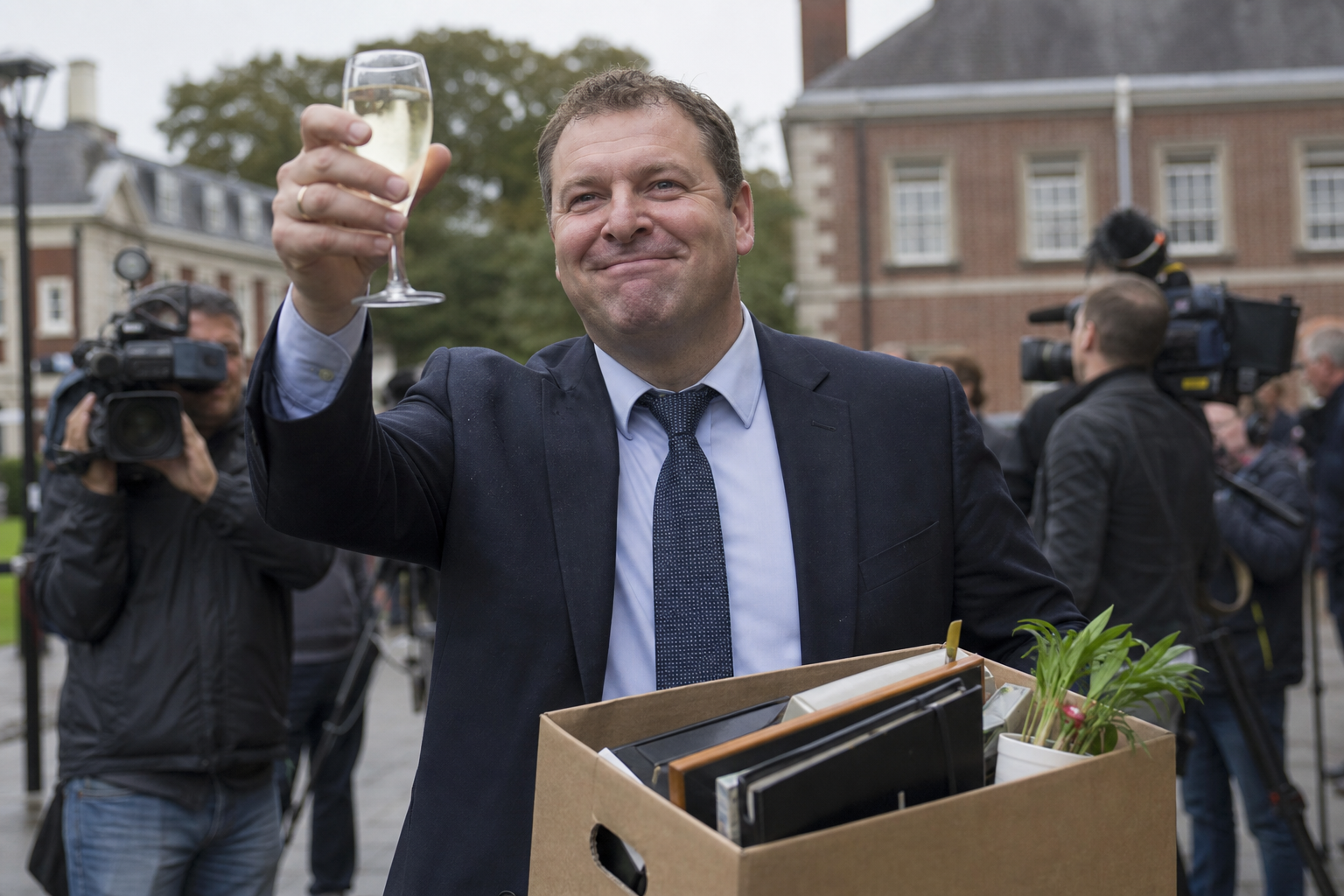
BERLIN, Germany. Friedrich Merz, chancellor of Germany and leader of the CDU, announced this week that he has no intention of resigning following his party's worst-ever performance in a state election, delivering the news in a tone typically reserved for men explaining why the check engine light is probably nothing.
The result in question came out of Thuringia, where the CDU's share of the vote collapsed to a level the party has never seen before in any state election in its history. Merz's response was to hold a press conference, describe the loss as an opportunity for reflection, and confirm he would be keeping his calendar.
In political circles this is sometimes called resilience. In most other workplaces it would generate a very different kind of meeting.
Merz told reporters that the German people deserve stable leadership, which is a sentence that functions as both an argument and a threat depending on how you read it. He said the party would analyze what went wrong, incorporate the lessons, and emerge stronger. He did not specify what any of those words meant, but he said them with the confidence of a man who has never once been asked to clean out a desk.
"What we are seeing is not a verdict on the direction of this government," Merz said at a press availability on Wednesday. "It is an invitation to communicate more clearly, to listen more deeply, and to demonstrate in concrete terms that our values are the values of the German people." He then took no questions.
Inside the CDU, the mood was described by multiple sources as tense, which in German conservative politics translates roughly to a situation where people are saying very careful things in very quiet rooms while maintaining eye contact slightly longer than necessary.
Several party figures have reportedly raised the question of whether Merz is the right person to lead the CDU into the next federal challenge, framing it as a matter of strategic recalibration rather than, for example, the obvious thing. Merz, for his part, has characterized this pressure as a sign that the party is engaged and serious, which is the political equivalent of calling the noise your car makes a feature.
What has been largely avoided in Merz's public statements is any reckoning with the actual votes. The CDU lost to the AfD, the hard-right party that German mainstream politics has spent years warning the public about, in a state where the CDU once considered itself the natural governing force. The AfD did not win because of some structural anomaly or protest-vote fluke. It won because a substantial number of people in Thuringia looked at the CDU and made a choice, and the choice they made was not the CDU.
Merz's analysis of this situation, as delivered publicly, is that the CDU needs to communicate its values more effectively. This is a bit like a restaurant losing all its customers and concluding the problem was the font on the menu.
His approval ratings have been declining since the early months of his chancellorship, a period during which he rolled out a series of migration policies sharp enough to alienate the center and not quite sharp enough to win back anyone who had already moved to the AfD. The result is a CDU that has spent several months gesturing toward a politics it does not fully believe in, for a voter bloc that does not fully trust it, while the actual far right watches from the lead and waits.
Merz is staying on. He has made that clear. The party has accepted this, in the way that people accept a filling they didn't ask for at a dentist's appointment they forgot to cancel.
The next state elections are in several months. The chancellor's schedule is open.
The story we are making fun of: https://www.bloomberg.com/news/articles/2026-09-20/merz-s-cdu-posts-worst-state-result-in-postwar-german-history