Absurdity
Right-Wing Think Tank Finds Voting Rights Act 'Too Effective' at Protecting Voting Rights
By BSN Staff, . BSN Network. Satire.
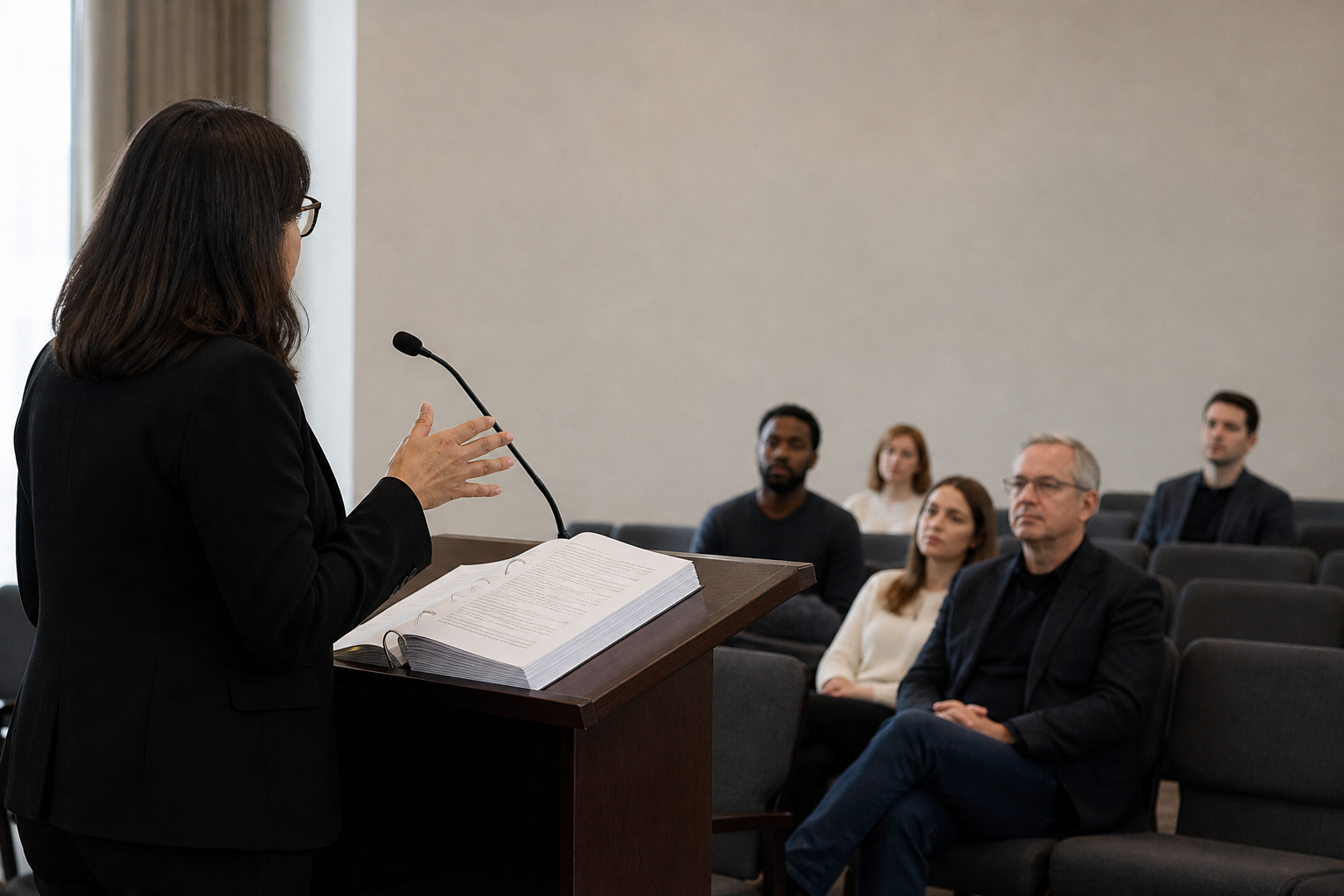
WASHINGTON, D.C. -- The American Heritage Policy Center released a landmark 212-page report Thursday concluding that the Voting Rights Act of 1965 has, after six decades of continuous operation, become dangerously proficient at protecting voting rights, a development the organization described as 'outside the original scope of sustainable democratic participation.'
The report, titled 'Restoring Balance: When Civil Rights Legislation Exceeds Its Mandate,' was produced by a 14-member panel over 18 months, at a cost the Center declined to disclose, in a building whose address is also unlisted.
'We want to be very clear that we support voting,' said Center president Dr. Warren Holt at a Thursday morning press conference attended by eleven people and one man who appeared to be there for a different event. 'We simply believe that a law this effective at achieving its stated purpose raises serious questions about scope, intent, and whether the framers ever anticipated it would actually work.'
The report identifies what the panel calls the Act's central design flaw: it disproportionately benefits people who are, in the panel's phrasing, 'actively attempting to vote.' According to the Center's analysis, this creates a structural imbalance in which protected groups experience measurably fewer barriers to casting a ballot, which the report categorizes under the heading 'Overcorrection.'
The 14-member panel recommends replacing the current enforcement model with what it calls a 'Tiered Access Framework,' under which voting rights would be protected on a sliding scale based on 'historical participation metrics,' 'residential continuity indices,' and a third criterion the report describes only as 'civic readiness,' defined in Appendix D as 'not further defined in this document.'
Federal election law professor Dr. Sandra Obi, who was not involved in the report, read the executive summary and took a long drink of water before commenting.
'They have written 212 pages,' she said, 'to argue that a law should stop doing what it does. That is an incredible amount of paper to spend on that sentence.'
The Center pushes back on that characterization. Senior fellow Douglas Pratt, who authored three of the report's chapters and the acknowledgments page, said the panel's concern is not with voting itself but with what he called 'the velocity of enfranchisement.'
'There is a rate at which a democracy can absorb new participants,' Pratt told reporters, 'and the Voting Rights Act has, frankly, not respected that rate. The result is a system where people who face obstacles to voting have those obstacles removed. That is not a neutral outcome.'
Asked what a neutral outcome would look like, Pratt said he was glad the question was raised and then answered a different question.
The report also flags what it calls a secondary concern: the Act's success has made it difficult to argue against in public, which the panel describes as 'a rhetorical externality that warrants legislative review.'
The Center is recommending Congress form a bipartisan commission to study whether the Voting Rights Act should be scaled back to a level of effectiveness that does not, in the report's words, 'generate the current level of controversy among people who oppose it.'
As of Thursday afternoon, three senators had praised the report without reading it, two had read it and praised it anyway, and one had requested a shorter version with more charts.
The Voting Rights Act, reached for comment, continued to function normally.
This is satire. The events and quotes are invented and none of it is real news.
Satire & Commentary BSN publishes satirical commentary on real events alongside entirely fictional stories. Content may include invented quotes, fictional scenarios, and exaggeration for humor and should not be read as strictly factual reporting.