State Bans Background Checks to Protect Criminals' Privacy Rights
By Jeff Garstein, . BSN Network. Satire.
This article was generated using AI under BSN Network's editorial guidelines and was not individually reviewed by a human editor before publication.
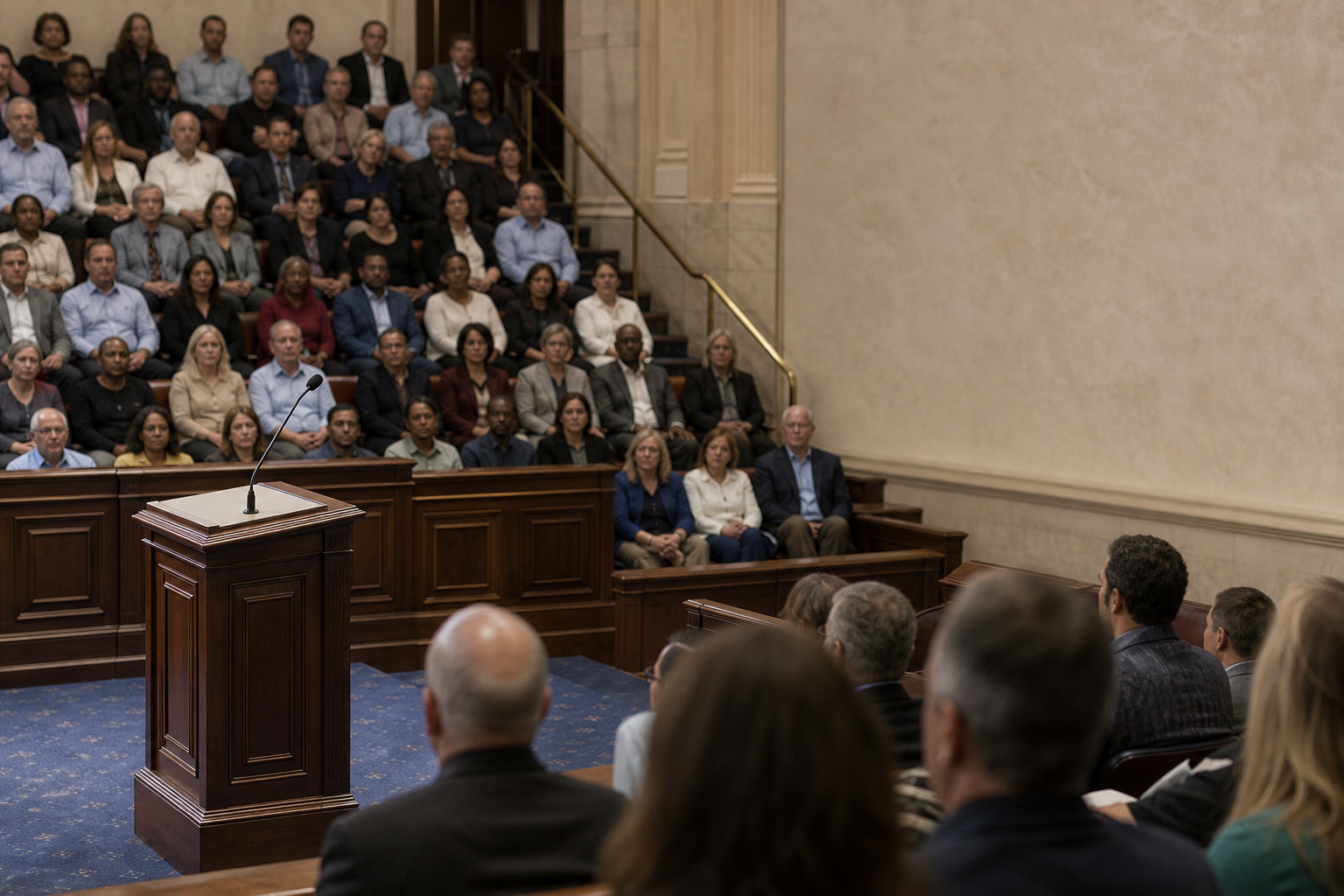
Image created with AI.
CAPITOL CITY, VALORIA. Governor Dennis Prull signed the Applicant Dignity and Record Privacy Act into law Wednesday, making Valoria the first state in the nation to prohibit the use of criminal background checks across all employment, housing, and consumer lending decisions, effective immediately, except in cases where the applicant has already told you, which the law does not require them to do.
The bill passed the state legislature 61 to 38 after three hours of debate, two recesses, and what witnesses described as a very long personal statement from State Senator Greg Foulds, who was not available for comment by press time because he had left early.
Governor Prull, speaking from the steps of the capitol building in front of a crowd estimated by his office as large, called the bill a long-overdue correction to a system that allowed employers to use a person's documented history of behavior as a basis for predicting their future behavior, which the governor described as "frankly a little presumptuous."
"What happened in a person's past is between that person, the court system, the parole board, their victims, any registered databases, the detective who filed the report, and God," Governor Prull said. "It is not for a Jiffy Lube manager to go poking around in."
Under the Act, employers may still conduct interviews, check references, and require work samples. They may not, however, run a criminal background check, request that an applicant disclose prior convictions, or Google the applicant's name followed by the word "arrested." The law specifies that the third prohibition applies even if you add a city name.
The legislation was drafted by the state Office of Applicant Dignity, a body created by the same bill, and staffed initially by volunteers whose backgrounds were not checked because the office did not yet legally exist when they were hired.
Advocates for the bill say it addresses a structural inequity in which people who have committed crimes are repeatedly disadvantaged by the fact that they committed crimes, creating what State Director of Workforce Equity Pamela Orr called "a cycle where the past keeps happening to you."
"We looked at the data," Orr said, at a press conference held in the Office of Applicant Dignity's new headquarters, which is a room. "People with criminal records are significantly less likely to be hired than people without them. We asked ourselves: why. And I think the answer we landed on, ultimately, is that employers know."
The law includes a private right of action, meaning applicants who believe a company has run a background check on them may sue for damages of up to $10,000 per incident. Companies may defend themselves by proving they did not look, which legal experts say will be easy to prove in most cases and impossible to prove in all the others.
Businesses have reacted with what the Chamber of Commerce called "alarm" and what Governor Prull called "adjustment."
"We're a daycare," said Marcus Thill, owner of Sunridge Learning Center in the city of Dunnvale. "We have thirty-four children between the ages of two and five. I asked my lawyer if there was an exception. He said the exception is that I can ask the children's parents for references. I said the references are for the children. He said that is a different law."
The Act does include one exception: background checks remain legal for positions in law enforcement, on the grounds that officers need to be familiar with the system from a professional standpoint.
The opt-out form, for applicants who voluntarily choose to waive their privacy and permit a background check, runs to four pages, requires a government-issued ID, two character references, and a notarized statement of intent. Processing time is six to eight weeks. The form itself, per Section 14(c) of the Act, may not be used as the basis for a background check.
Governor Prull said he was proud of what the state had accomplished and looked forward to a Valoria where people were judged on their merits, their character, and their willingness to show up on time, rather than on any documented evidence of what they are like as a person.
His office did not respond to questions about whether the governor had signed the bill with the pen he used to veto last year's public records expansion, but sources familiar with the situation said probably.
BSN Network is a satire publication. This article, its quotes and its byline are fiction written for comedy.
This is satire. The events and quotes are invented and none of it is real news.
Satire & Commentary BSN publishes satirical commentary on real events alongside entirely fictional stories. Content may include invented quotes, fictional scenarios, and exaggeration for humor and should not be read as strictly factual reporting.