Politics
Supreme Court Will Decide If Deportations Are Legal Once Everyone Is Already Gone
By Mor Michael, . BSN Network. Satire.
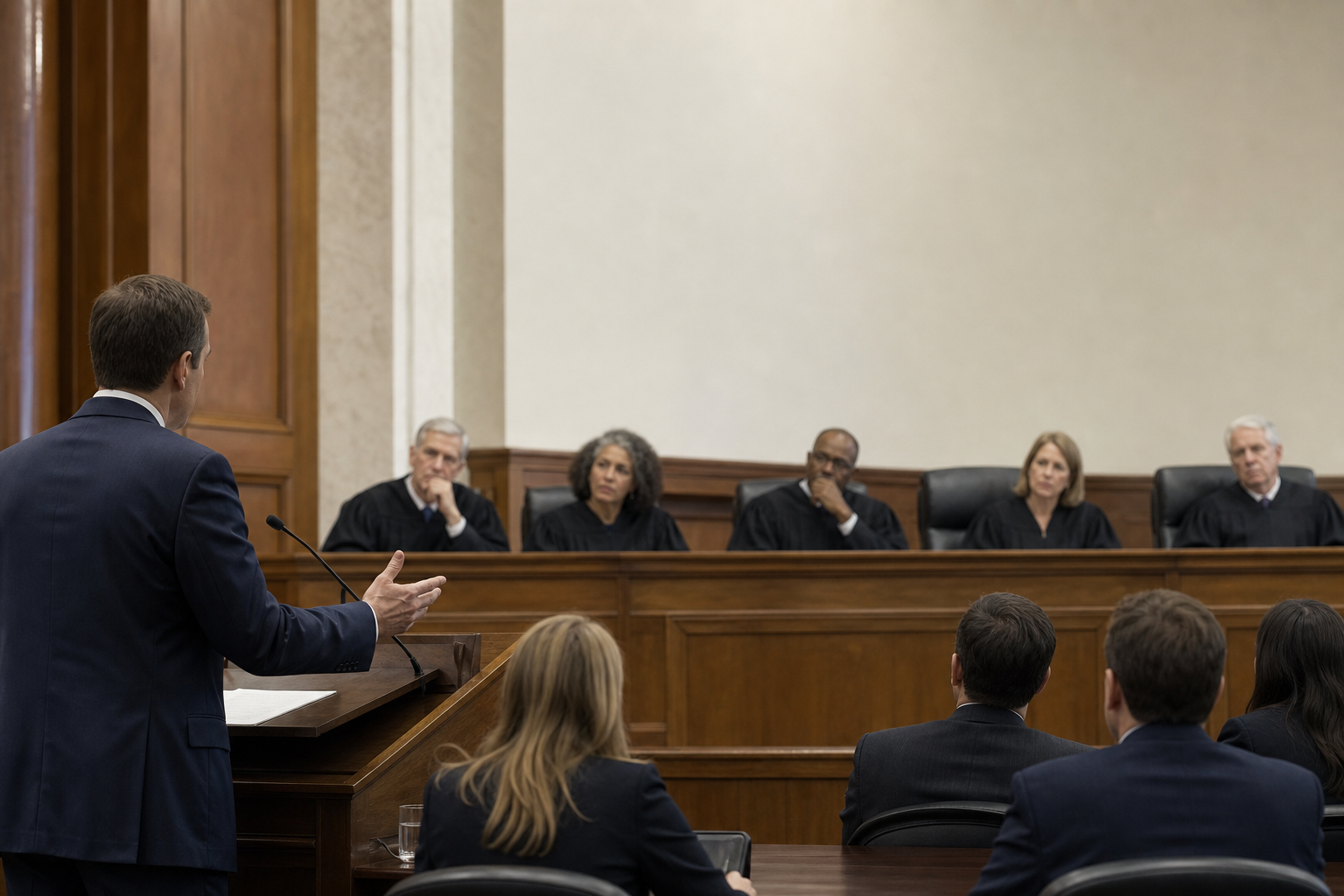
WASHINGTON, D.C. -- The Supreme Court announced Monday that it will hear arguments on whether the Trump administration can deport migrants to third countries with which those migrants have no legal relationship, no citizenship, no family, no language, and in several documented cases, no prior awareness of the country's existence.
The case will be heard later this year. The deportations will be heard right now.
The Court's order was three paragraphs long. The first said the justices would take up the constitutional question. The second preserved the administration's authority to keep removing people while that question remains open. The third was a standard procedural notice. There was no fourth paragraph acknowledging what the first three paragraphs meant when read together.
ICE has been operating under a program that allows migrants to be removed to countries that are neither their country of origin nor the country they entered from, a legal category so novel that even the administration has not settled on a name for it. Internal documents have referred to it as "third country removal," "alternative jurisdiction placement," and, in one memo obtained by a federal court, "expanded flexibility resettlement," which sounds like a mattress company's return policy and functions about the same way.
The administration argued before the Court that pausing removals while the case is litigated would cause irreparable harm to border enforcement operations. The migrants subject to those removals argued that being sent to a country they have never been to might also constitute a form of harm, irreparable or otherwise. The Court found the administration's position more time-sensitive.
Solicitor General D. John Sauer told reporters the ruling reflects the Court's confidence in executive authority over immigration matters. "The President has broad, inherent, and well-established constitutional power to determine where individuals who are not citizens of this country should be," Sauer said, before a follow-up question about which countries, specifically, briefly interrupted his composure.
Critics of the ruling noted that the legal standard for "third country" removals has never been defined by statute, litigated to completion, or, according to three immigration law professors contacted for this story, fully understood by anyone currently implementing it.
"What we have," said Professor Arielle Moss of Georgetown Law, "is the executive branch exercising a power whose legal basis is simultaneously under Supreme Court review and operationally active. That's not unprecedented. It is, however, a very strange way to run a legal system if your goal is to know whether what you're doing is legal before you do it."
Moss added that she had reviewed the administration's brief and found it "confident in a way that is not entirely supported by the pages that follow."
Representatives of the affected migrants told the Court that several of their clients had already been transferred to countries where they do not speak the language, hold no documentation, and have no existing legal status. One filing noted that a client had been removed to a country he had previously been unable to locate on a map provided by his attorney, which his attorney acknowledged was "not a legal standard, but felt relevant."
The Trump administration has described the third-country removal program as a necessary tool for managing migrants from countries that refuse repatriation agreements. Seventeen countries currently decline to accept deportees from the United States. The administration's solution to this impasse was to locate a third country willing to accept them instead, a policy that shifts the problem geographically while the legal question of whether that shift is permitted travels, at a considerably slower pace, toward nine people in robes.
Oral arguments are expected in October.
The flights are not waiting for October.
The story we are making fun of: https://www.newsweek.com/map-of-third-countries-where-supreme-court-allowing-ice-to-deport-migrants-12503915