Absurdity
Columbus’ Jewish heritage finally drives official adoption of Indigenous People’s Day
By BSN Staff, . BSN Network. Satire.
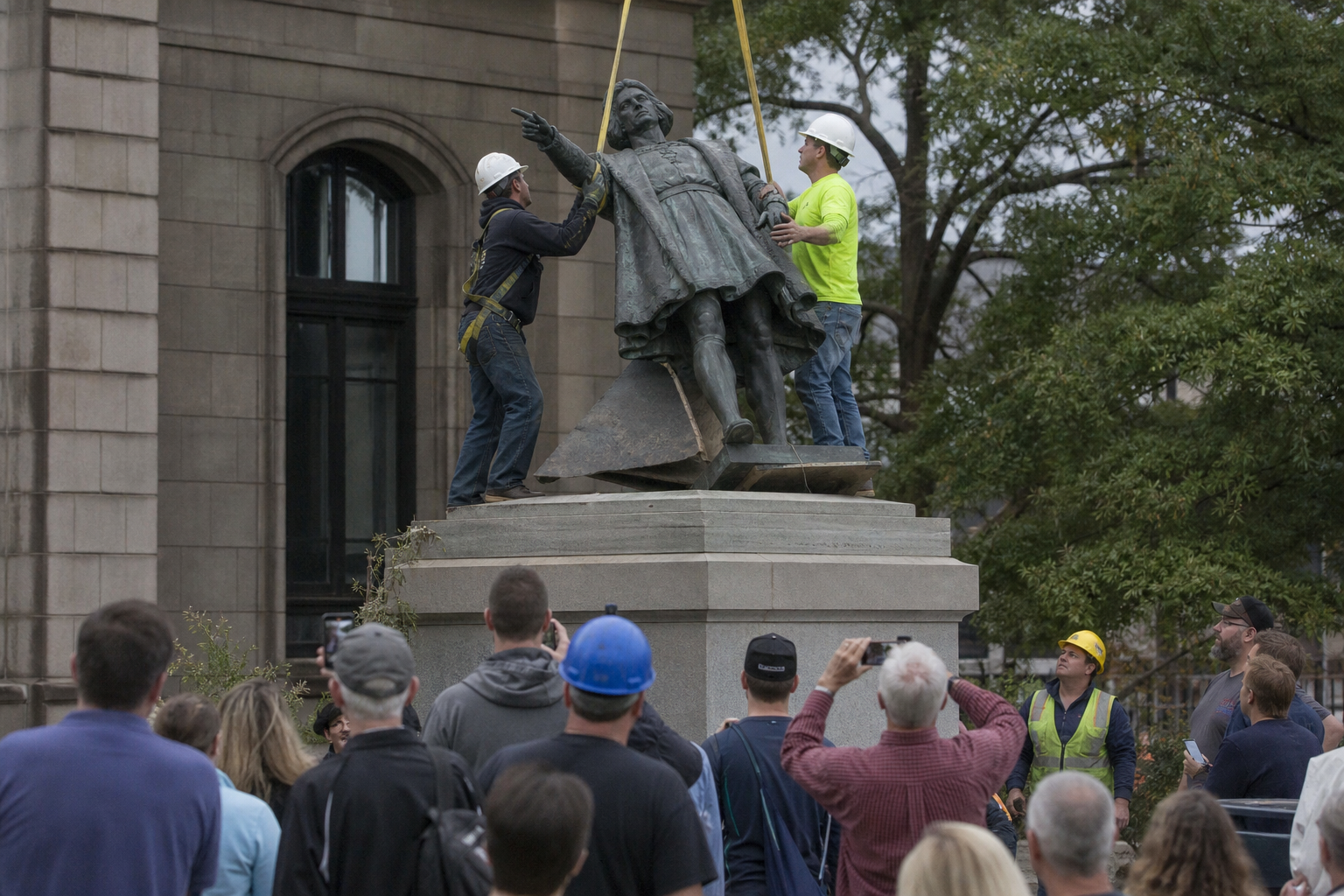
WASHINGTON, D.C. (BSN): After more than thirty years of protests, legislation, and increasingly uncomfortable elementary school pageants, Columbus Day has been officially replaced by Indigenous Peoples' Day on the federal calendar. The triggering event was not, historians note with some exhaustion, the enslavement of the Taino people. It was a DNA report.
Researchers at the University of Granada published findings last month suggesting that Christopher Columbus was almost certainly of Sephardic Jewish origin, descended from Jews who had converted to Catholicism during the Spanish Inquisition to avoid expulsion or death. The paper, which had been circulating in academic circles for years, went viral on a Tuesday, which is apparently all it takes now.
Congress moved within seventy-two hours.
"We have always honored Columbus as a symbol of bold European Christian exploration," said Rep. Dale Furrish (R-OH), who had voted against Indigenous Peoples' Day legislation four times since 2019. "The moment we learned he was something else entirely, it became clear we needed to reassess the holiday. Out of respect. For history."
Rep. Furrish declined to specify which part of history.
Advocates who have spent decades arguing that Columbus committed documented atrocities against the people he encountered, including mass amputation, forced labor, and the systematic destruction of entire civilizations, expressed a complicated reaction to the news.
"We're glad it happened," said Marisol Reyes of the Indigenous Justice Coalition, choosing her words with the care of someone defusing a bomb. "We are choosing to be glad it happened. We are not going to examine why it happened. We are putting that in a box."
The box, sources say, is quite large.
Columbus himself, were he available for comment, would likely have several objections. Historians point out that he died insisting he had reached Asia, petitioned the Spanish crown for back pay until his final years, and almost certainly had no idea that five centuries later a genealogy scandal would accomplish what decades of Indigenous activism could not. In this way, Columbus remains on brand.
The renaming has not been without controversy. Several Italian-American groups, who have long claimed Columbus as a symbol of their own historical legitimacy in America, held a press conference in South Philadelphia to announce they felt "blindsided on multiple fronts."
"First you tell us he didn't discover America, now you tell us he wasn't even Italian," said Anthony Castellano of the Sons of Columbus Society, standing in front of a banner that had not yet been updated. "At this point I don't know what we're even celebrating. We've been doing the parade for sixty years."
A spokesperson for the White House Office of Historical Reconciliation, which was created sometime in the last paragraph, issued a statement describing the renaming as "a meaningful step toward a more inclusive national narrative that honors the full complexity of our shared past going forward as a nation together."
The statement did not mention the Taino people by name.
Elementary schools across the country are now scrambling to update curricula. Several districts in Ohio and Texas have requested guidance on whether the Nina, the Pinta, and the Santa Maria can still be used as a craft project, or whether that too requires further genealogical review.
Indigenous Peoples' Day is scheduled to be observed on the second Monday of October, the same date as Columbus Day, using the same federal holiday infrastructure, the same postal closures, and the same car dealership sales events.
The Taino people could not be reached for comment, for reasons that predate this article by about five hundred and thirty years.