Politics
Friedrich Merz Gets Character References From His Own Government To Prove He Runs It
By Mor Michael, . BSN Network. Satire.
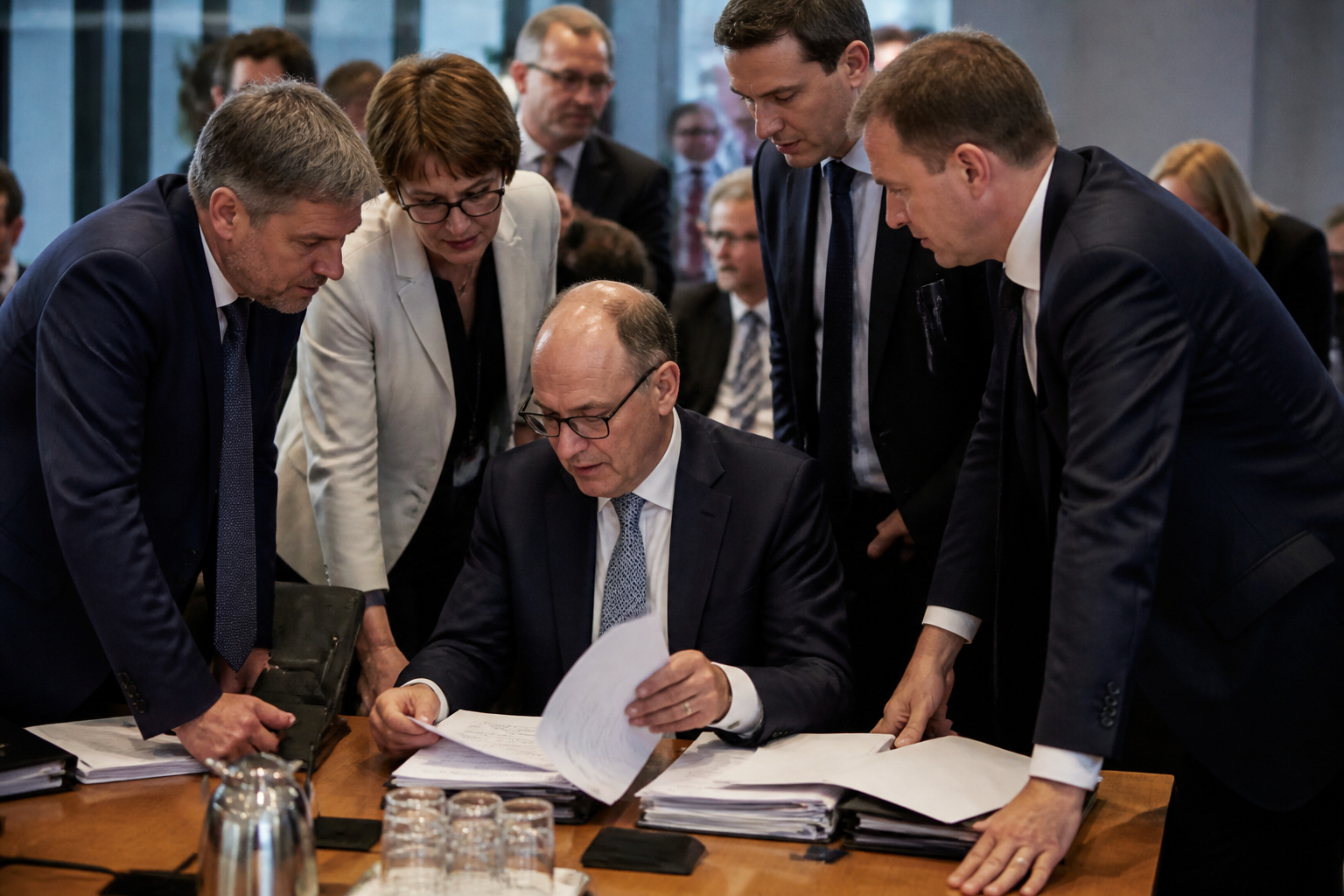
BERLIN -- Friedrich Merz, the German Chancellor who has now led Europe's largest economy for sixteen months, spent the better part of this week collecting written assurances from the people who technically work for him that he is, in fact, in charge. The endorsements came from the sixteen state premiers of Germany's federal system, a group whose formal function is regional governance and whose informal function, as of Thursday, appears to be emotional support.
Merz's conservative CDU/CSU bloc faces two regional elections this Sunday in states where early polling suggests the results will be somewhere between bad and much worse. Backing from the premiers does not change any of those numbers. It is, structurally, a press release saying that everyone in the building agrees the building exists.
The Chancellor's office released a statement describing the premiers' support as a reflection of shared purpose and renewed coalition confidence. Asked what specifically had been renewed, a spokesperson cited the statement.
Elon Musk, who spent several months in early 2025 posting enthusiastic endorsements of Germany's far-right AfD party on X and telling his followers that Merz represented the old, useless establishment, did not comment on the premiers' endorsement. He was presumably busy deciding which other country's elections needed his input before breakfast.
The AfD, which Merz has repeatedly refused to formally govern with while also adopting enough of their immigration positions to make the distinction largely academic, is polling competitively in both regions. Political scientists describe this as a paradox. Voters appear to describe it as a reason to vote for the original.
Karl-Josef Laumann, the CDU premier of North Rhine-Westphalia and one of the sixteen signatories, told reporters that the party was unified behind the Chancellor and that Sunday would be an opportunity to demonstrate stability. He then paused in a way that suggested he had done the math on Sunday and was keeping the math to himself.
Merz, for his part, has governed through three separate confidence crises since taking office, which is either proof of resilience or proof that German political institutions have the structural integrity of a Bavarian coalition budget. He was asked at a press conference this week whether the premiers' backing changed his position going into the weekend. He said it demonstrated that Germany spoke with one voice. A reporter noted that Germany was about to speak with two regional ballots. Merz said that was also correct.
The two elections are in regions where Merz's conservatives have historically performed well, which is the part of the sentence that explains why this week required sixteen character references rather than a single confident press release.
Germany has, since the end of the Second World War, constructed one of the most elaborately stability-oriented political systems in democratic history: proportional representation, federal checks, coalition requirements, constructive votes of no confidence, the whole apparatus. The system was designed so that no one person could seize control. It was not specifically designed for the scenario where no one person can maintain it either, but here everyone is.
The premiers will return to their respective states this weekend. The elections will proceed. Whatever the results are, they will be described in a joint statement as a foundation for continued dialogue.
Merz retains the chancellorship. He has the paperwork.
The story we are making fun of: https://www.bloomberg.com/news/articles/2026-09-16/merz-wins-backing-from-state-premiers-as-party-braces-for-losses