Culture
New York Mayoral Candidate Promises Every Citizen Identical Sandwich at Noon
By BSN Staff, . BSN Network. Satire.
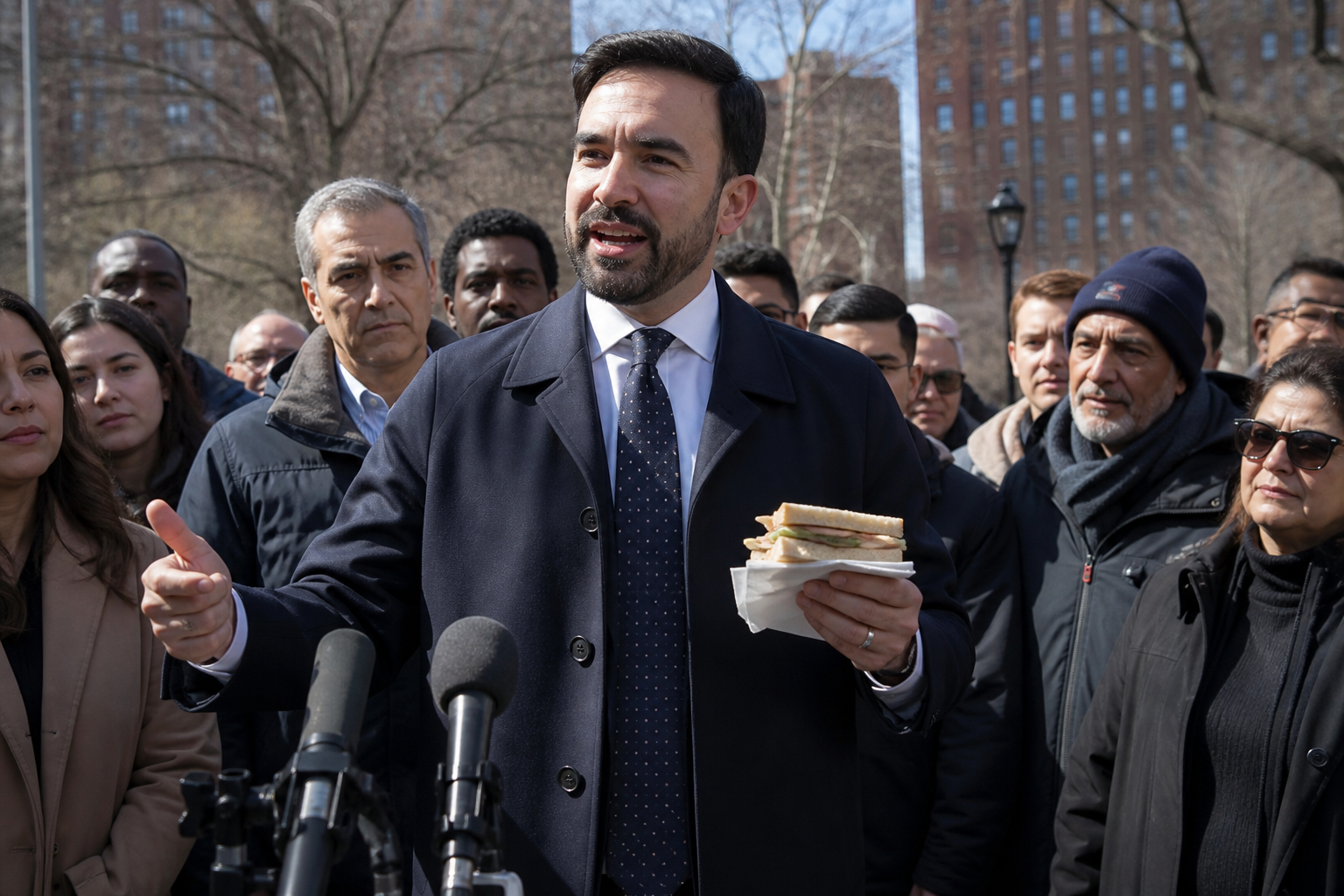
NEW YORK, NY, Zohran Mamdani, candidate for Mayor of New York City, unveiled what supporters are calling a landmark framework for municipal fairness and what everyone else is calling a policy that treats human beings like printer paper, identical, interchangeable, and most useful when stacked neatly in a tray.
The plan, which critics have taken to calling the Race Plan in tones ranging from concern to outright despair, sets what Mamdani's campaign describes as outcome benchmarks across housing, education, employment, and, according to page forty-seven of the supporting documentation, recreational fishing.
"We are not interested in the door being open," Mamdani told a crowd in Astoria last Tuesday. "We are interested in everyone walking through it at the same time, in the same shoes, having taken the same number of steps to get there."
The crowd applauded. Several people in the back looked at their shoes.
Denise Falucci, 44, a school administrator from Flushing, said she was initially supportive until she read the section on academic outcome calibration, which she described as, quote, "the part where they explain that if one kid gets an A and another gets a C, that's the emergency, not the other way around."
"I have two sons," Falucci said. "One studies. One does not study. I love them both. But they are not the same."
She paused.
"The city cannot make them the same. I have tried for seventeen years and I have access to their food."
The campaign's Director of Equitable Futures, a position that did not exist four months ago, issued a statement clarifying that the plan does not seek to eliminate individual achievement but rather to, quote, "decouple achievement from its historically asymmetric distribution across communities defined by race and class in ways that reproduce existing hierarchical disadvantage structures."
Asked what that meant, the director said it meant fairness.
Asked what fairness meant, the director said it meant the plan.
Political analysts note that the distinction between equal opportunity and equal outcome, while sounding like a bumper sticker argument, is in fact one of the oldest and most consequential disagreements in democratic governance, one that entire libraries have been written to address, and one that Mamdani's campaign appears to have resolved by simply not acknowledging it exists.
Roger Hecht, 61, a retired civil rights attorney who spent three decades fighting discrimination in housing, said he agrees with the impulse behind the plan and objects, strenuously, to nearly everything else about it.
"You want equal opportunity? I'm with you until I fall down," Hecht said. "You want to mandate equal outcomes? Now you need a bureaucracy large enough to monitor every outcome, and someone has to decide what counts as equal, and that someone is always, always, the person who drafted the form."
He added that in his experience, the people most enthusiastic about designing equal outcome systems are also the people most confident they will be designing them.
City Council members have expressed mixed reactions, with several noting that the plan's goals are admirable, its mechanisms are vague, its timeline is aggressive, and its glossary alone runs to nineteen pages.
Mamdani's campaign maintains that critics are simply afraid of change.
Critics maintain they are specifically afraid of this change, which is a different thing, and they would appreciate it if that distinction were noted somewhere in the nineteen-page glossary.
The general election is in November.
The sandwiches, presumably, are already the same.
The story we are making fun of: https://nypost.com/2026/09/05/opinion/mamdanis-race-plan-sets-dangerous-goals-thank-goodness-its-unlikely-he-delivers/